How to Improve Your Balance as You Age: 5 Simple Exercises to Stay Strong and Steady
Fitness - October 16, 2026
When was the last time you thought about your balance?
Maybe it was when you stepped off a curb and caught yourself, or you were walking down the stairs carrying something, or you stood on one foot while putting on your pants and realized it wasn't quite as easy as you expected.
We tend to think of balance as something we either have or don't have. But balance isn't a fixed ability. Balance is a skill. And like strength, mobility, and endurance, it's something you can train.
As we get older, our balance naturally changes. Our muscles may become weaker, our joints may become less mobile, and the systems that help our brain understand where our body is in space don't work quite as efficiently as they once did. Research suggests that some decline in balance can begin as early as our 50s.
The good news is that getting older doesn't mean you have to accept poor balance as inevitable. Regular exercise and targeted balance training can help you maintain and and improve your ability to stay steady and in control.
Why Is Balance So Important?
Balance is about much more than standing on one leg.
Think about everything you do throughout the day that requires you to stay steady while your body is moving. Walking, going up and down stairs, getting in and out of a car, stepping over something on the floor, reaching for an object, changing direction, or getting up from a chair all require some level of balance.
Good balance allows you to control your body while you're standing still and while you're moving. And that becomes especially important as we get older.
Falls are one of the biggest concerns associated with poor balance, particularly in older adults. But the goal of balance training isn't simply to prevent a fall. It's to help you maintain the strength, coordination, confidence, and independence you need to keep doing the things you enjoy.
You don't want to wait until you feel unsteady to start working on your balance.
Balance and The Changes With Age
Balance is actually a pretty complicated process.
Your brain is constantly receiving information from your eyes, inner ear, and sensors in your muscles, joints, and tendons that tell you where your body is and how it's moving. Your brain takes all of that information and uses it to help you stay upright and control your movements.
As we age, any of these systems can become less efficient.
Changes in vision, inner-ear function, medications, mobility, muscle strength, or other health conditions can all affect balance. But one of the biggest things we can influence is physical strength and movement.
You can't control every part of how your balance changes with age. But you can work on your strength, mobility, coordination, and ability to control your body. This is where exercise comes in.
Static vs. Dynamic Balance
When we talk about balance, there are two basic types to think about: static balance and dynamic balance.
Static Balance: your ability to stay upright and controlled while you're relatively still. Standing on one leg is a simple example. It gives us a foundation for more complex movement.
Dynamic balance : your ability to stay controlled while in motion. Walking is a great example.
Every step you take requires you to shift your weight from one leg to the other, control your body, and prepare for the next step. Going up stairs, stepping off a curb, reaching while moving, and walking on an uneven surface all require dynamic balance.
You might have no problem standing on one leg but still struggle with balance while you're walking or changing direction. That's why it's important to train both. Balance isn't just about how long you can stand still. It's about how well you can control your body when life doesn't keep you perfectly still.
Your Legs and Core Play a Big Role
Good balance requires your whole body to work together, but your legs and core play an especially important role. Your legs need enough strength to support your body and control your position. Your hips, knees, ankles, and feet are constantly making small adjustments to keep you stable.
Think about stepping off a curb. You need enough strength in one leg to support your body, enough control to lower yourself, and enough balance to keep yourself upright as your other foot reaches the ground. That's strength and balance working together.
Your core also plays an important role. Your core isn't just your abdominal muscles. It's the muscles around your trunk that help stabilize your spine and pelvis and control your body as you move. When you walk, climb stairs, carry groceries, or reach for something, your core helps transfer force between your upper and lower body and keeps you from losing control.
**This is one of the reasons strength training is such an important part of balance training. **Balance exercises teach your body how to control itself. Strength training gives your body the strength it needs to actually make those corrections. You need both.
How Can You Train Your Balance?
The good news is that balance training doesn't have to be complicated. You can add a few simple exercises into your existing routine or even practice them during everyday activities. For all of these, start off near a wall, countertop, or chair for support if needed. As your balance improves, reduce the amount of assistance.
Single-Leg Balance
Keep your chest tall and your eyes looking forward. Hold onto the support as you need it. Start off with maintaining that for 10 seconds, if that’s too easy lengthen it.
Tandem Stand
Stand with one foot directly in front of the other, with the heel of your front foot touching the toes of your back foot. Hold the position for 10 seconds to start, then switch which foot is in front. Again, as it gets easier increase the time
Heel-to-Toe Walking
Now take that same position and turn it into movement. Walk forward slowly, placing the heel of your front foot directly in front of the toes of your back foot. Take 10 steps forward, turn and take 10 steps back to where you started
Marching
Stand tall and slowly alternate lifting one knee at a time, with the goal of getting your knee as high as your hip. As you become more comfortable, focus on controlling each step rather than simply moving your legs quickly. The slower the better
Side Stepping
Face sideways and take slow and controlled steps to one side, one foot, then bring the other foot to join it. Take 10 steps there then 10 steps back, in the opposite direction.
Make Balance Part of Your Training
One of the biggest mistakes we can make is waiting until something becomes difficult before we start training it. You don't wait until you're weak to start strength training. You don't wait until you're completely stiff to work on mobility. And you shouldn't wait until you're unsteady to start working on your balance.
Balance training can be as simple as adding a few minutes to the beginning or end of your workout. You can also incorporate it into exercises you're already doing.
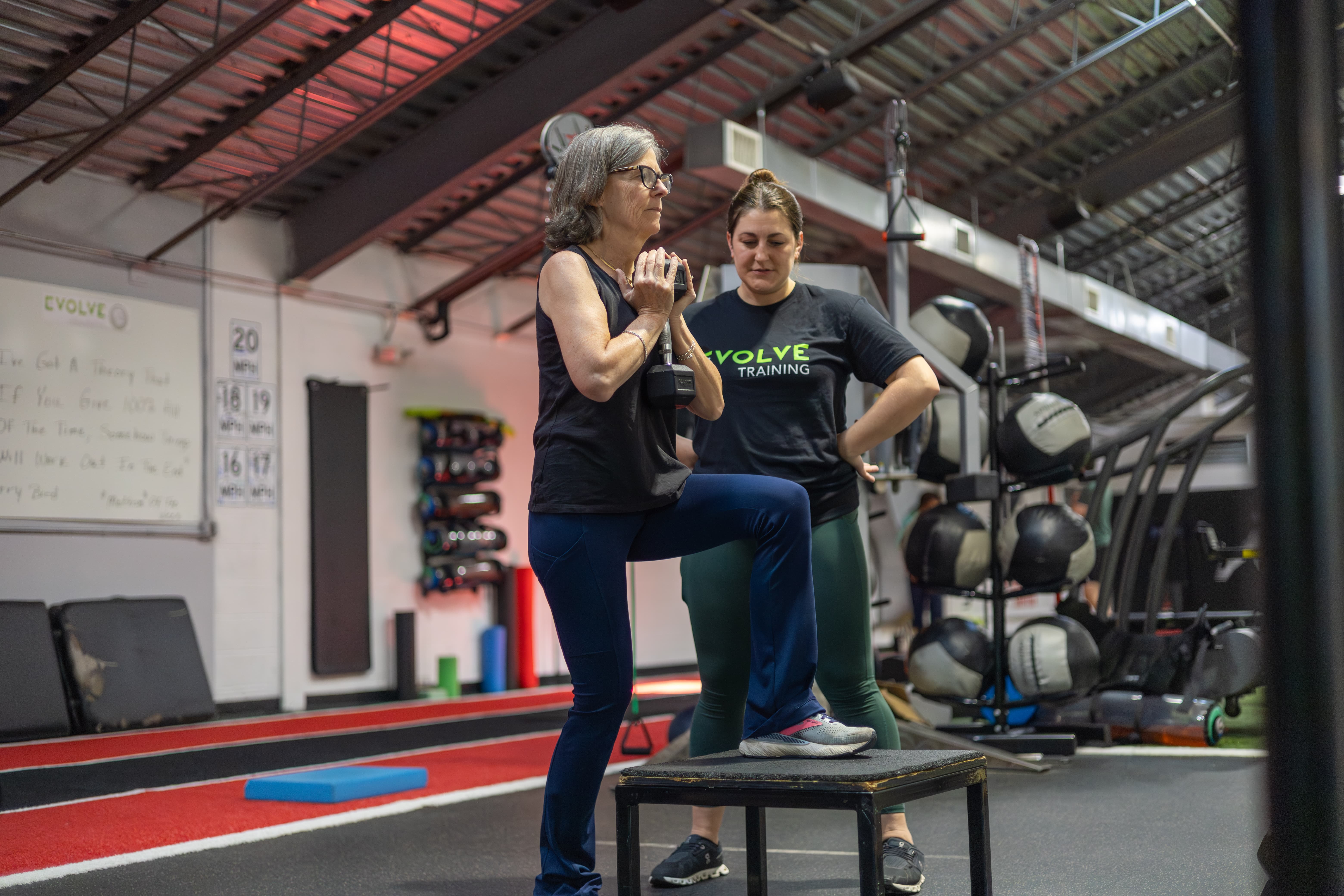
For example, your trainer may have you in a staggered stance while doing an overhead press, do a suitcase carry, step in different directions, or perform a controlled single-leg movement. These aren't just exercises for the sake of exercise, they're ways of working in dynamic balance into an existing routine.
And remember, balance exercises should be challenging, but also be safe. If you're unsteady, use a wall, countertop, railing, or sturdy chair for support.
Start Training the Skills You Want to Keep
We often focus on the things we want to improve right now. We want to get stronger. We want to lose weight. We want to move better. We want to have more energy.
But exercise is also about protecting the abilities you want to have years from now.
You want to be able to walk confidently. You want to be able to climb the stairs. You want to be able to get up off the floor. You want to be able to play with your grandchildren, travel, play sports, carry your groceries, and move through your day without constantly worrying about losing your balance.
Those abilities don't happen by accident. You train and prepare for them.
You can't completely stop the changes that come with aging, but you can give your body a reason to stay strong, mobile, coordinated, and capable.
Balance is a skill. Starting training for it before you start to miss it.
Want to Feel Stronger, Steadier, and More Confident?
At Evolve Training, we help adults build strength, improve mobility, and develop the balance they need to stay active and independent. Our personalized, one-on-one training programs are designed around your abilities, goals, and comfort level.
Contact us to learn how we can help you move better and feel stronger at any age!